The Watercraft
As my father would say, “let’s get things straight” with some official definitions:
Kayak – a light, narrow boat, usually propelled by a double-bladed paddle. It has an elongated shape, sits low in the water, and can be open or closed (with a cockpit). Kayaks are used for recreation, sports, expeditions, and navigation on lakes, rivers, or the sea.
Canoe – a light boat, usually open at the top, propelled by a single paddle. It has higher sides than a kayak, allows the transport of several people or luggage, and is used for recreation, touring on calm waters, or sports.
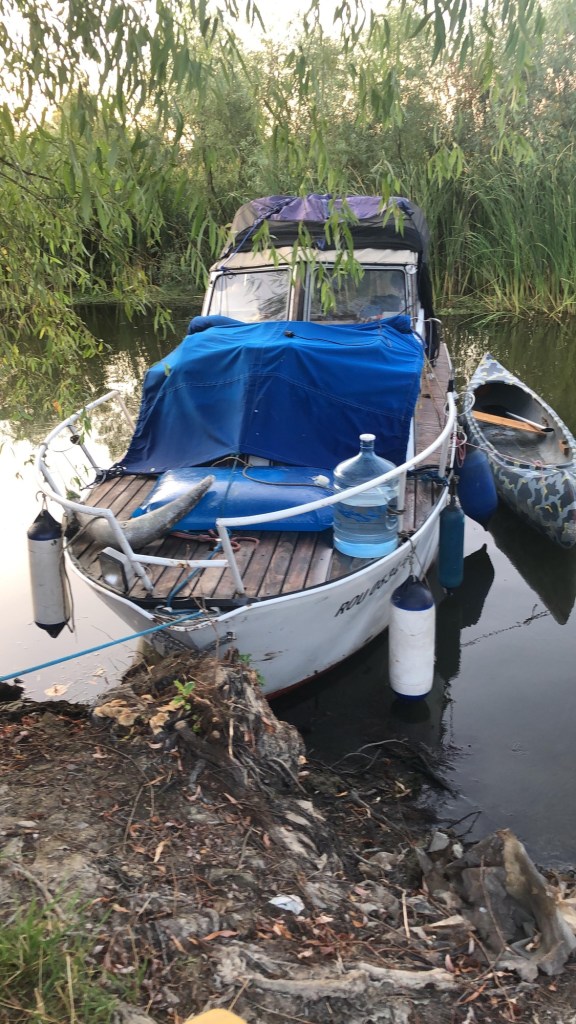
I asked Mișu to tell me again how he met the German on the Sulina Canal.
The man had set off from the Black Forest in Germany and gone down the Danube with the intention of reaching the Black Sea in Romania.
About 10 km from Sulina, he came across Mișu, who had also stopped for the night. After chatting for a while, the German left him his boat, as he couldn’t take it with him on the train on his return journey anyway.
Mișu sent me some pictures. I was able to look closely at the boat, zoom in on the photos, see the paddle: definitely a canoe! (Now that I know better, I can listen to Mișu calling it a kayak without it bothering me anymore. I know what it really is!)
Our man takes it to Bucharest, introduces it to the rest of the fleet, befriends them, repairs it, takes care of it, patches it up, prepares it, loses the original paddle, and buys some toy paddles.
How he thought he could control the boat — an animal of the sea — with a small motor and two paddles I’ll never know!
But he tried, and for ten meters he had a great time, like a child with a new toy. Eternally young at heart!
The Shipwreck
I recommend you be patient and watch the whole movie because l I’m not going to explain or summarize it. If you miss it, you’ll deprive yourself of a masterpiece! Try to ignore the sound or, even better, mute it. Still learning some things.
Memories
This takes me back a few decades, to one of my famous outings with my dad, which started out relaxed and invariably ended with the question, “How did we get out of that?”
I was in high school. My dad had bought a Russian rubber dinghy: big, heavy, ugly, and green like a puddle covered with frog spawn. It came with the usual wooden oars and some rubber cushions to sit on, which you inflated using your lungs, as the air pump had been waylaid or misplaced somewhere. Naturally, the loss was deemed all my mother’s fault, even though she didn’t even know my dad had bought a boat and kept it in that big, ugly bag. Come to think of it, one of the many “aunts” we used to go with might have simpy hidden it out of spite or some other equally irrevocable reason. (Cousin Cat recounts: “Cousin, we really liked going with Nashu (my dad), wherever he took us, but what I didn’t understand for a long time was why there always had to be an ‘aunt’ with us who wasn’t Nasha (my mom)?”) At any rate, the boat had two chambers: one in the front, one in the back. Thus, the division of labor was simple: my father inflated one chamber, I inflated the other. The cushions were easy.

Dad finished quickly: he blew once, took two puffs from his cigarette, drank three big sips of vodka, blew once more, and that was it. He had such strong lungs that he blew the machines at every medical checkup. Meanwhile, I was red as a lobster and panting like a locomotive, struggling to inflate the rubber. When he was already getting ready to fall asleep, exhausted by the sun, I managed to finish. Victory! I was ready for adventure.
We jumped into the boat. I took the oars. The boat, large and light (on the water), picked up speed under the influence of the currents. My father was fast asleep, snoring like a boat engine, and I suddenly felt very powerful. In point of fact, I wasn’t actually “going” anywhere: the current was carrying me and the wind was pushing me, but who cared about such details?
Eventually, it occurred to me to look around. The shore was small. Very small. And very far away! A thin line on the far horizon! “Hey, let’s go back!” I said. And that’s when the drama began.
I started rowing. Vigorously. Did the boat move forward? No. The boat stayed in place, or even seemed to go backwards, out to sea, as if to mock me.
My father woke up and, with his characteristic wisdom, offered me some parental encouragement: “Come on, son, row! What, are you sleeping there?
I rowed even more vigorously. My father got angry: “Come on, you idiot. Come over here so I can do it! I’ll show you!”
We switched places. My father picked up the oars, warmed up his wrists, and expertly completed six strokes. Since I had nothing better to do, Iactually counted. On the sixth stroke, there was a resounding CRACK! He had broken one of the oars. He cursed loudly. At the Russians, at the boat, at me, at the wood, and at my mother, out of habit, even though she wasn’t there.
I looked at him. I looked at the shore. I looked at the broken oar. I had only one thought: “That’s it. That’s it. We’re staying here, living on seaweed and jellyfish until the coast guard comes to arrest us. And we’re also stark naked.”
Rowing with a single oar only caused nerves, parental words spoken with talent, and a general feeling of futile effort. To avoid hearing his nagging, I sacrificed myself like the hero in an Errol Flynn movie: I jumped into the water, took the boat’s rope between my teeth, and started pulling it toward the shore (at first, I had wanted to push it, but I couldn’t see where we were going, and when my father tried to steer, the oar he was wielding hit me in the head). Surprisingly, I was making progress! It was a period in my life when I swam a lot, very well and very fast (a period that didn’t last long). Unfortunately, I had no idea which way we were going. I had long since given up any idea of trying to reach the nudist beach from which we had launched, but I knew that at least the current was now helping us, taking us somewhere toward Mangalia. My father kept trying to use the oar as a rudder, which only made things worse. I naturally couldn’t comment on his efforts since my mouth was full of rope).
Finally, we reached the shore, still on the beach at 2 Mai, but among swimsuit wearers. We were quite a sight! I fell flat on the sand, wet, exhausted, but alive. A bystander, seeing the scene, said with a big smile, “You had fun, didn’t you?”
My father was ready to beat him senseless.
Discover more from Nea Fane - Un Biet Român Pripășit în America / A Hapless Romanian Stuck in The US
Subscribe to get the latest posts sent to your email.
 Nea Fane - Un Biet Român Pripășit în America / A Hapless Romanian Stuck in The US