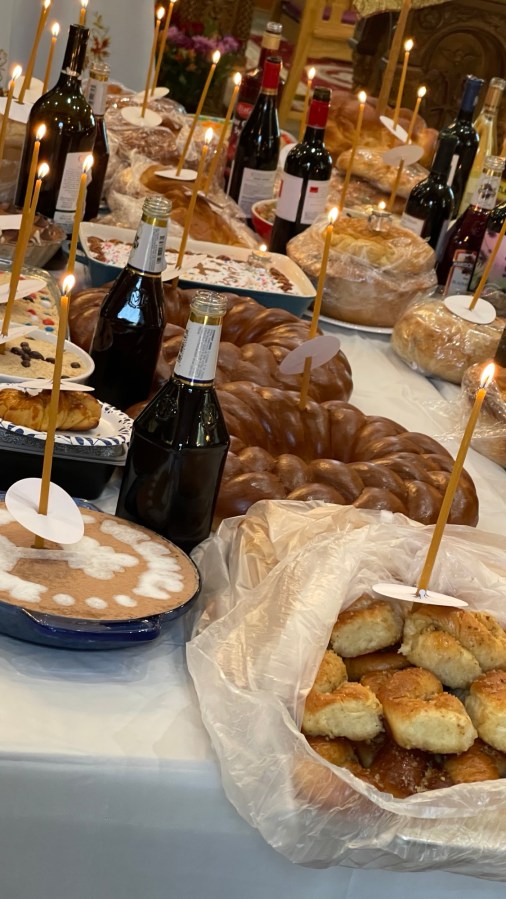
March 9th, 2024
Instead of Introduction
Detailed Glossary of Terms and Customs
| Coliva (koliva) | a dish based on boiled wheat that is used liturgically in the Eastern Orthodox Church for commemorations of the dead. Coliva is blessed during funerals, as well as during the memorial service that is performed at various intervals after a person’s death and on special occasions, such as the Saturday of Souls. While recipes may vary widely, the primary ingredient is wheat kernels which have been boiled until they are soft, then sweetened with honey or sugar. Coliva also contains some or all of the following: ground walnuts, cinnamon, vanilla, imitation rum. Romanians decorate the coliva with crosses of cocoa, chocolate or candy. (Source: Wikipedia) |
| Parastas | is a liturgical solemn service for the repose of the departed in the Eastern Orthodox and Byzantine Catholic churches. In the Eastern Church, the various prayers for the dead have, as their purpose, praying for the repose of the departed, comforting the living, and reminding the living of their own mortality and the brevity of this earthly life. For this reason, memorial services have an air of penitence about them. If the service is for an individual, it is often held at the deceased’s graveside. If it is a general commemoration of all the departed, or, if the individual’s grave is not close by, the service is held in a church, in front of a special small, free-standing “memorial table”, to which is attached an upright crucifix and with a candelabra for the faithful to put lighted candles. The memorial service is most frequently served at the end of the Divine Liturgy, hence, the duration. (Source: Wikipedia) |
| Sarma(le) | Sarma, commonly marketed in the English-speaking world as stuffed grape leaves, stuffed vine leaves, or stuffed cabbage leaves, is a food in Southeastern European and Ottoman cuisine made of vegetable leaves rolled around a filling of grains (such as rice), minced meat, or both. In Romanian cuisine, cabbage and grapevine leaves are not usually differentiated. In Romania and Moldova, sarmale (singular sarma) are popular in all historical regions. Sarmale are a central part of Romanian cuisine and are the national dish of Romania. Romania has a large garden and farm culture, and Romanians love to make sarmale, since they grow many of the ingredients, such as cabbage, near their homes. Each sarma usually consists of minced pork, rice, onion, eggs, thyme, and dill rolled in a leaf, usually a cabbage leaf (or grapevine leaf). During the fasting season of Lent, there are alternative versions of sarmale that might replace the pork with smoked fish and include vegetables such as grated carrots. It is typically accompanied by mămăligă (polenta) and sour cream. (Source: Wikipedia) |
| Bodgaproste | The word bogdaproste is of Slavic origin and is made up of three words that I will write in Latin, as they were pronounced: “Bog davai prastiti,” meaning “God grant you His mercy,” just as you show mercy to the one in need. This is the context of the Saturday in which all those departed are commemorated. (Source: episcopia.ca) |
| Mucenici | Mucenici is a Christian feast of the 40 Martyrs of Sebaste, a traditional holiday in Romania and Moldova. On the day of the martyrs (mucenici), in the popular belief, the tombs and the gates of Heaven are opened, and, in honor of the Holy Martyrs, the housewives make 40 coils called sfinți (Saints), mucenici or bradoși. In Moldova, they have the shape of the number 8, a stylization of the human form, and are baked from Cozonac dough, then glazed with honey and sprinkled with walnuts. In Dobrogea, the same anthropomorphic form is preserved, but the martyrs are smaller and are boiled in water with sugar, cinnamon, and walnuts, symbolizing the lake where the Holy Martyrs were thrown. The customs of March 9 form a ritual scenario specific to the coming of a New Year: the preparation of ritual food; spring cleaning; the ritual drunkenness attested by popular tradition; the opening of the tombs and gates of Heaven for the return of spirits among the living; lighting fires in courtyards and gardens, in front of the houses, and in the field; the purification of people and cattle by sprinkling holy water; beating the earth with the mayors to drive away the cold and take out the heat; finding luck in the new year by preparing the Mucenici cake; harvesting honey; and the cutting of the first vines. Their 8 shape is a symbol of infinity and union with the Cosmos, in alignment with the myth of the Heaven Gates opening. (Source: Wikipedia) |
The Memorial Service
Here we go again: this priest is all about the De Luxe Service, the long version for holidays. It’s like he gets paid by the word, droning on from 9 to 11:30 am. I can’t help but feel a twinge of envy for the blonde lady showing up at half past ten, bringing her whole entourage and lots of food. She totally messes up the table arrangement, throwing the priest off track; suddenly another table appears just for her. Irina filled me in on who she is and why she acts that way. We don’t really like her, but we don’t hate her either, just because we’re in church. We’re just indifferent. (I’ll share more about The Dacian, The Blonde, and the Bioenergeticist another time. Not the right moment for that now.)
We reached the second candle on the coliva, and the people started getting antsy: “God rest their souls, but, Father, speed it up a bit! The coliva’s warming up, the cabbage rolls are cooling, and the eggplant salad’s going off.”
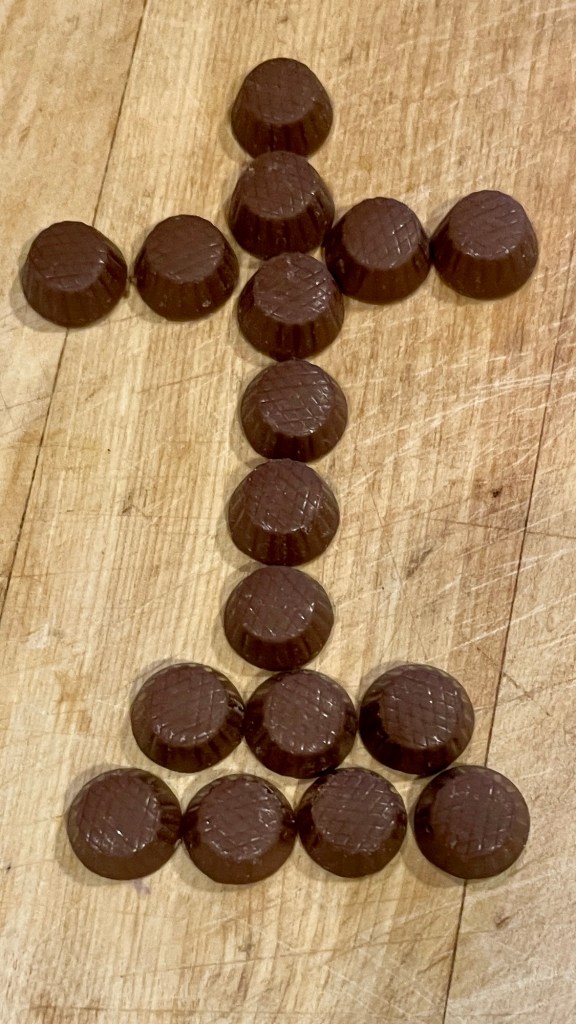
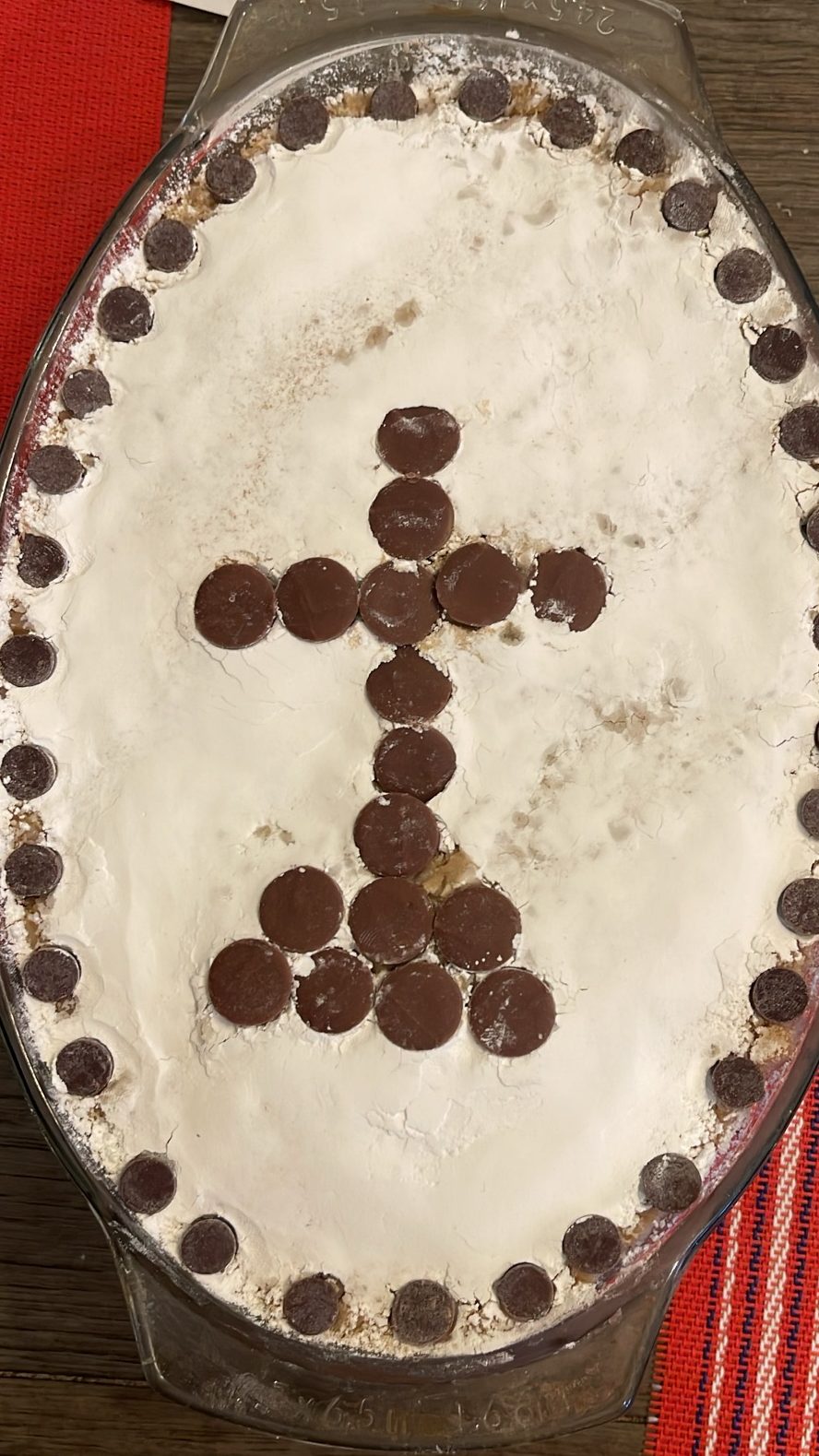
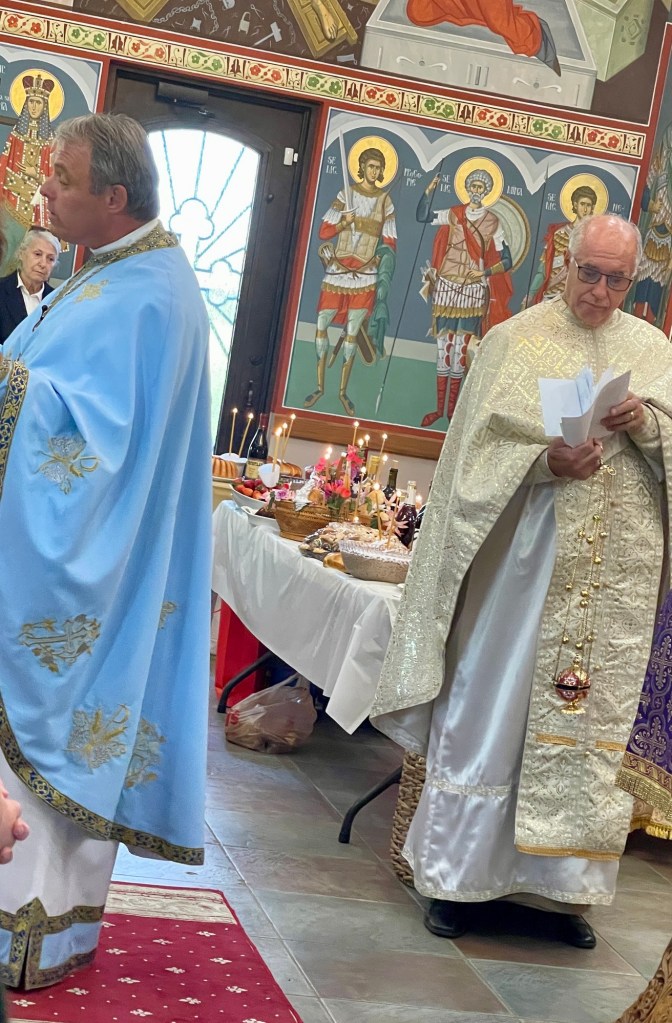
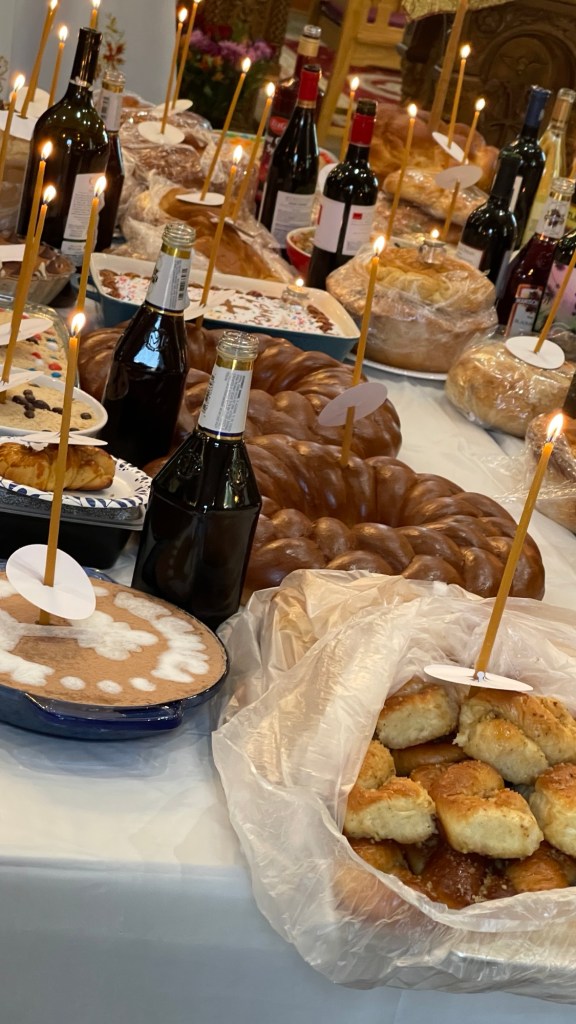
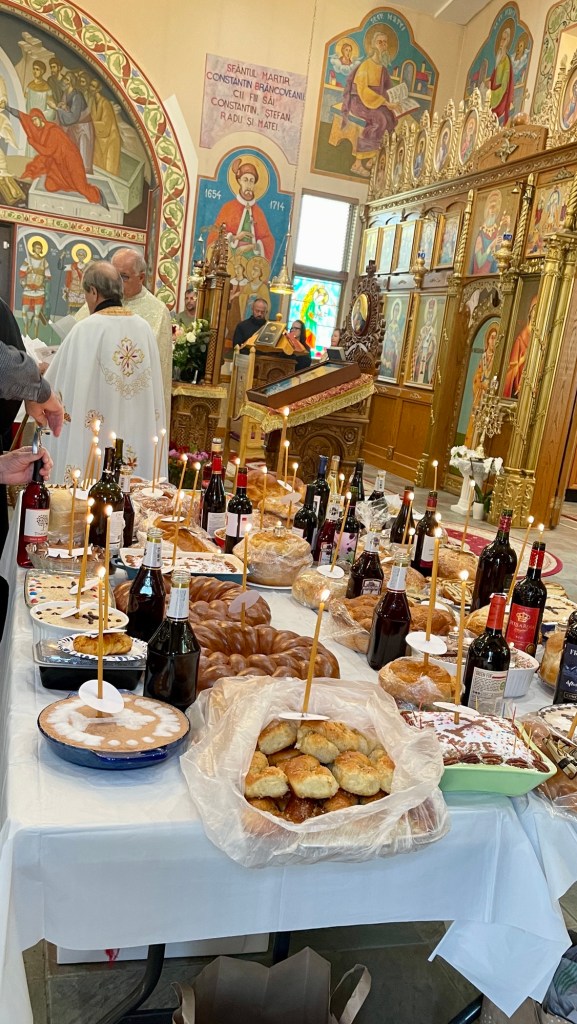
Pagan chat with my former classmates, during the service:
S: “Hey folks, fun fact for today: It’s The Holy 40 Martyrs’ Day, the Name Day of those who don’t have saint names. If you know someone in this category, give them a shoutout and wish them a Happy Name Day.”
C: “Give this playlist a listen: ’44 Wine Glasses For the Martyrs’ on Spotify. It’s like a sort of All Saints’ Day, you know? What’s interesting is there are 40 martyrs and they drink 44 glasses. Where do the extra 10% come from?”
V: “VAT, 10%”
S:” Even if my phone is on silent, if I open a Spotify playlist, it can still be heard. Even in church! Or especially in church!”
V: “That sucks.”
S: “I was at the Alleluia, and only the people next to me could hear it over the parishioners singing their hearts out. Then there’s old Popescu, the non-believer, whose phone started to blast ‘I Can’t Get No Satisfaction.’ “
Surprisingly, the lady next to me seemed to enjoy it because she handed me a big ol’ glass of wine later on, and I happily took it as my lady chauffeured us around.
The way we do it in this Popescu family is that, after we sing the Memory Eternal, when the priest says that we are done, and that we should go in the big hall and eat, we grab our coliva, the bread loaf, and the wine, and we head back home. We pack them up in smaller portions, find the quickest route using the Shortest Path Algorithm, and then we start visiting our friends to give them away the small bags we just made for them. We don’t exchange anything at church, we don’t give away food, and we don’t receive any food.
This time, though, a friend’s mom said, “Don’t leave, I got something for you in the car. And I also have a package with some food. Come on, come inside.”
This Saturday, the food sharing/giving away part of the parastas happened outside on the small patio, instead of in the great room where the Women’s Day Ball was supposed to happen later. It got really crowded and it was super hard to move around.
By the time we found his Mother at her table, giving away food, I already had (in my hand) a plate of sarmale and two baked Moldovan mucenici. On my way to her, I overheard a guy saying loud and clear that he had homemade wine, so I did my tricky footwork thing and sneaked away to grab a glass of the said good red wine. Smooth move, smooth wine, manly wine glasses. I reluctantly left them, I mean the guy and his wine, but then my lady just found me and sent me back for more sarmale. When I hesitated and said I didn’t want to go, she just said, “I’m shy and you’re chubby. I want the ones with grape leaves.” I bid farewell to the guy and left, feeling a bit down. I could see a mutual understanding in his eyes.
I received a couple more bags, and some containers with various foods, and fruits, and wine. Some people we knew come to every religious holiday, others were newcomers, but they all had something in common: the love with which they cook and make the packages, the boundless sadness and longing for those who have passed. No one holds a parastas to have fun: everyone does it carrying the eternal memories of loved ones. There were people where there was a queue for food, they came with cast-iron pots, or fancy stoneware, there were also more reserved people, who seemed pretty reluctant to offer their food, thinking that it not good enough. I loved them the most and I honored their dishes. The unwritten (or written) rules are: if you are offered coliva, food, or wine, you accept. You say Bogdaproste. If you accept it, you eat it; it is a great sin to be thrown away. What I do, extra (and this is a “me” thing), I don’t criticize any food. Everybody worked for it: to buy the ingredients, to cook it … it’s just not nice.
Meanwhile, things got pretty awkward for us. We got enough food for a week (or so I hoped – I write this Monday and all is almost gone).
I really wish I could just chill for a bit, once everything calms down, and hear their story, if they feel like sharing. But for now, we had to rush home to make sure the food in the trunk, already filling up between a shy one and a chubby one, wouldn’t go bad. The other option, to leave everything in the car with the AC on full blast, wasn’t doable anymore since the car’s AC had just conked out (which totally sucks in Arizona, especially with summer on the way).
At home, when I was opening the packages, I could totally imagine my Cosmin chuckling:
“Hey, Dad, look at this! You have sweets to open a bakery! Is this cheese still good? Yup, it is! Ooo, these little plastic bags are awesome. Don’t toss them, they’re too good. Still on the plastic bag kick, huh? When are you gonna upgrade to boxes? Well, even those plastic containers are great, the ladies use the good stuff for the good stuff.”
Discover more from Nea Fane - Un Biet Român Pripășit în America / A Hapless Romanian Stuck in The US
Subscribe to get the latest posts sent to your email.

 Nea Fane - Un Biet Român Pripășit în America / A Hapless Romanian Stuck in The US
Thank you for the extended English version. Without your ‘basic vocabulary’ and additional explanations it would be difficult for anglophones to understand the Romanian traditions. Indispensable for them. Well done. C.
On Mon, Mar 11, 2024 at 5:53 PM Nea Fane – Un Biet Român Pripășit în
LikeLiked by 1 person
I’m wondering who told me to do so…😉
LikeLike